THE PLAN · 13 MIN READ
How an Organiser Plans a Bachelor Party, End to End
Most of the work happens before anybody lands. Here is the whole sequence, in the order it really happens, with the lead times and the numbers.
Peter Bank · Founder
· UPDATED 15 SEPTEMBER 2026
TABLE OF CONTENTS
- 1.It starts with one message, and one decision maker
- 2.What we need before we can price anything
- 3.The lead-time ladder, week by week
- 4.What a Bangkok night actually looks like on the clock
- 5.Where the money actually goes
- 6.Choosing venues, and why we name so few
- 7.Transport, which is where most plans fail
- 8.Briefing twelve men who have not read anything
- 9.What the groom gets told
- 10.What goes wrong, and what we do about it
- 11.Doing it yourself, honestly
- 12.Questions groups ask us before they book
You have been asked to organise this, and you are somewhere you have never been. The venues are names you cannot pronounce. Nothing you read agrees on what anything costs. Half of the group has not replied to the chat, and the flights are already booked.
This is the whole sequence, written out. What we ask, in what order, how far ahead each piece has to be locked, where the money goes, and the five things that go wrong. If you read it and decide to do it yourself, that is a fine outcome. You will do it better for having read it.
It starts with one message, and one decision maker
The first message is almost always short. A date, a number of men, and the word Bangkok. That is enough to start.
The first thing we establish is not the budget. It is who decides. A group of twelve will produce twelve opinions and at least three men who want to change the plan from the airport. We will happily talk to two or three people, and in practice a best man and one other do most of the talking. But one name has to be the final answer, and everybody in the group needs to know whose name it is.
If you take one thing from this article, take that. Whether you use an organiser or not, appoint one person to decide. Groups that do this have a good trip. Groups that vote have a night that starts at eleven and is still being discussed at one in the morning, in a street, in the heat.
What we need before we can price anything
Six things. Nothing else moves until we have them.
The date, and whether it is a weekend. The head count, and how firm it is. Where the group is staying, or whether we are finding that too. What the groom does and does not want, which is a separate answer from what the group wants. A budget, even a rough one. And the single most useful question of all, which is what the group did last time.
That last one tells us more than the budget does. A group whose last trip was a villa in Ibiza wants something different from a group whose last trip was a curry house and a strip club in Manchester. Both are easy to plan for. Planning for the wrong one is expensive.
We do not need a preference on venues. Most groups do not have one, and the ones who arrive with a list have usually built it from articles written by people who have not been.
The lead-time ladder, week by week
Time is the one thing nobody can buy back. This is what each window actually buys you.
Four to six weeks out. Everything is available. We shortlist venues, hold the accommodation, and if a villa is in the plan we go and look at it. This is the only window where you get a genuine choice of villa on a weekend.
Two weeks out. Deposits are paid, the accommodation is confirmed, and the club tables are held. Choice has narrowed, particularly on Friday and Saturday. Nothing here is a problem.
One week out. Drivers are assigned by name, the group chat is opened, and the running order is fixed. A premium club table really wants a week. Below that you are taking whatever the room has left, which on a busy Saturday is the table by the door.
The day before. The groom's own briefing, and a one-page overview the group can actually read on a phone. Times, addresses in Thai, driver names, one phone number.
Forty-eight hours. This is the floor for a villa and a club table together. It can be done. You will not get the villa you would have chosen four weeks earlier, and you will pay weekend rates for whatever is empty.
The day itself. Drivers watch the live flight. If the plane is two hours late, nobody in the group needs to know that the whole evening has just been rebuilt.
What a Bangkok night actually looks like on the clock
Bangkok has a hard rule that decides the shape of your evening, and nobody tells visitors about it until they are standing outside a closed bar. Most of the city stops serving at two in the morning. Three entertainment zones run to four. Everything about the order of a night follows from that one fact.
So a night that works looks like this. Dinner from eight, and two hours is right. Groups always think they want ninety minutes and they always want two hours. Bars from ten, two of them, maybe three, and they are chosen for being near each other rather than for being the best bars in the city. A group of twelve loses twenty minutes every time it moves, and taxis in Bangkok will not take twelve men anywhere as one party.
The main event goes in from around eleven. If that is a club table, eleven is when you want to be sitting at it, not queueing for it. If it is a private room, it is when the room is at its best.
Then the decision at two. Either the night ends, which is a perfectly good outcome and the groom will thank you, or it moves to a late zone and runs to four. Decide this in advance. Deciding it at two, in a street, with twelve opinions, is how a good night becomes a bad one.
Where the money actually goes
Here is the part most planning articles leave blank. We will use real published figures, and they are The PIMP's own, because they publish them and can be checked.
A large private party room at The PIMP is ฿10,000 for the night and takes up to thirty men. The pool zone is ฿15,000 and takes up to a hundred and fifty. Bottles start at ฿6,000, and a liquor package starts at ฿20,000 and saves around thirty per cent against buying the same bottles one at a time. Hosts and models are charged by the hour: ฿2,000 for the first hour for a PR host, ฿3,000 for a dancer, bikini or model, then ฿1,000 an hour after that in every case. Prices there are net, VAT included, with no service charge added, and a bottle you do not finish is kept for twelve months. Most clubs in the city add ten per cent service on top, so compare carefully.
Put those together and a party room night for ten men with a five-bottle package and ten models for two hours comes to ฿72,000, which is a little over ฿5,000 a head for those two hours. The PIMP publishes a typical spend of ฿5,000 to ฿15,000 per person per night. Their own bachelor packages run from ฿71,500 for a four-hour small-room night to ฿232,000 for five hours in a suite with twenty-five girls.
Our packages sit on top of that. They start at ฿100,000 for the group and run to ฿450,000, and the difference between the tiers is not really the club night. It is how many nights, whether accommodation and a daytime event are inside it, and whether there is a second city in the trip. The club night is the biggest single line, and you can see exactly what it costs.
Two rules we hold to. The price agreed before booking does not change afterwards. And anything the group orders on the night that is outside the agreement is the group's own bill, settled by the group, not quietly added to an invoice three days later.
Choosing venues, and why we name so few
You will notice that articles like this one rarely name a venue. There is a reason, and it is not secrecy. It is that a venue is right for a specific group on a specific night, and a name printed in an article is a recommendation to everybody, which is a recommendation to nobody.
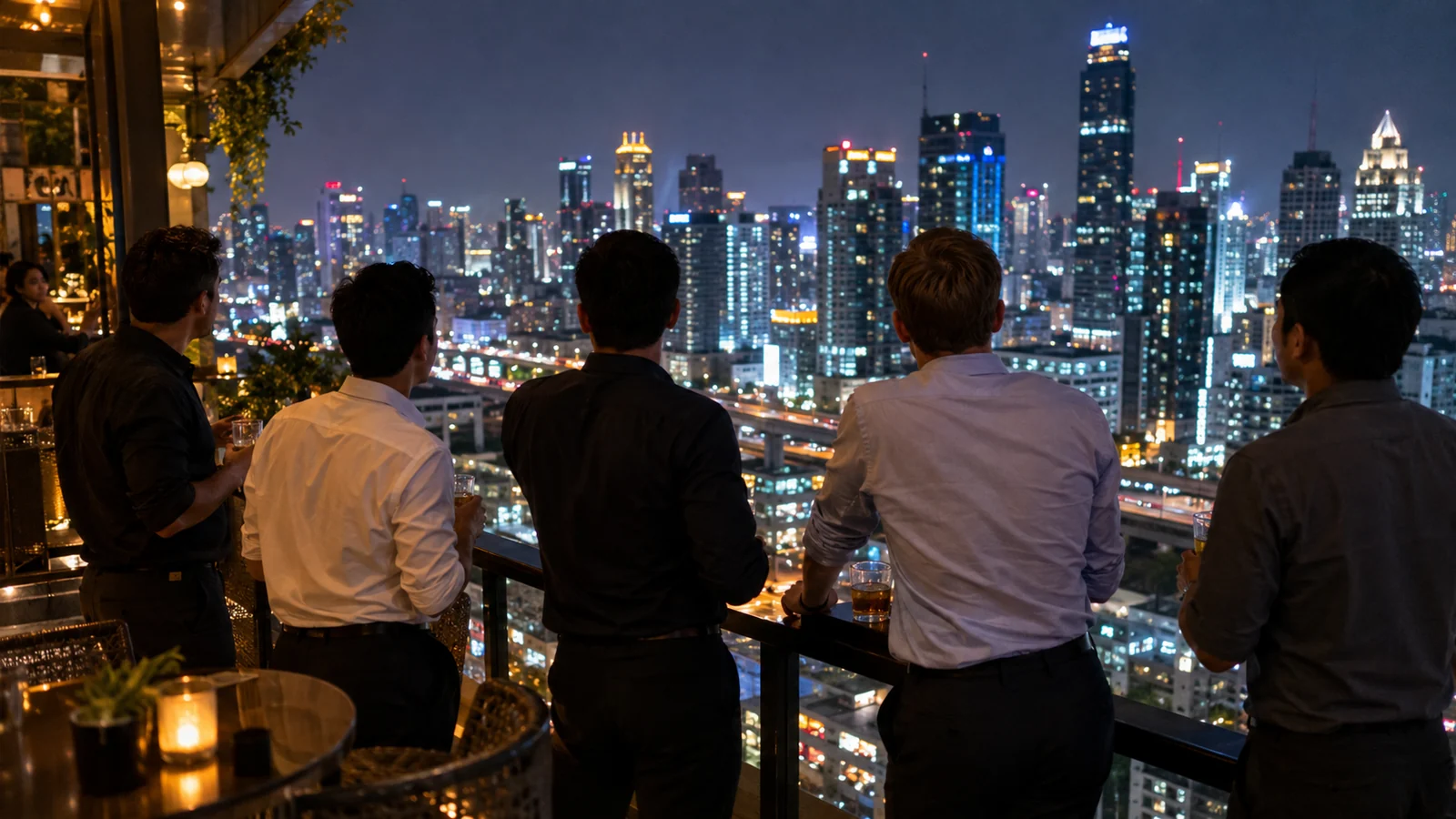
What we will say plainly is this. For a late-night party in a private room with hosts, there is one gentlemen's club we recommend, and it is The PIMP. That is the only one. We do not send groups somewhere where the room and the people in it are not up to the night you have paid for.
For a nightclub, a rooftop, a VIP table in a big room, that is a completely different night and it is not The PIMP. A group that wants a rooftop and a club is a real group and we plan that night properly, in the right places, with a table held under a name.
One genuinely useful specific: some of the best rooms in this city do not take reservations at all. Tichuca is the obvious example, walk-in only, and on a weekend there is no way to guarantee entry for twelve men. If a plan depends on a venue like that, the plan has a hole in it. We either arrive early or we do not build the night around it.
Transport, which is where most plans fail
This is the section groups skip and then regret. It is also the single clearest argument for using somebody local.
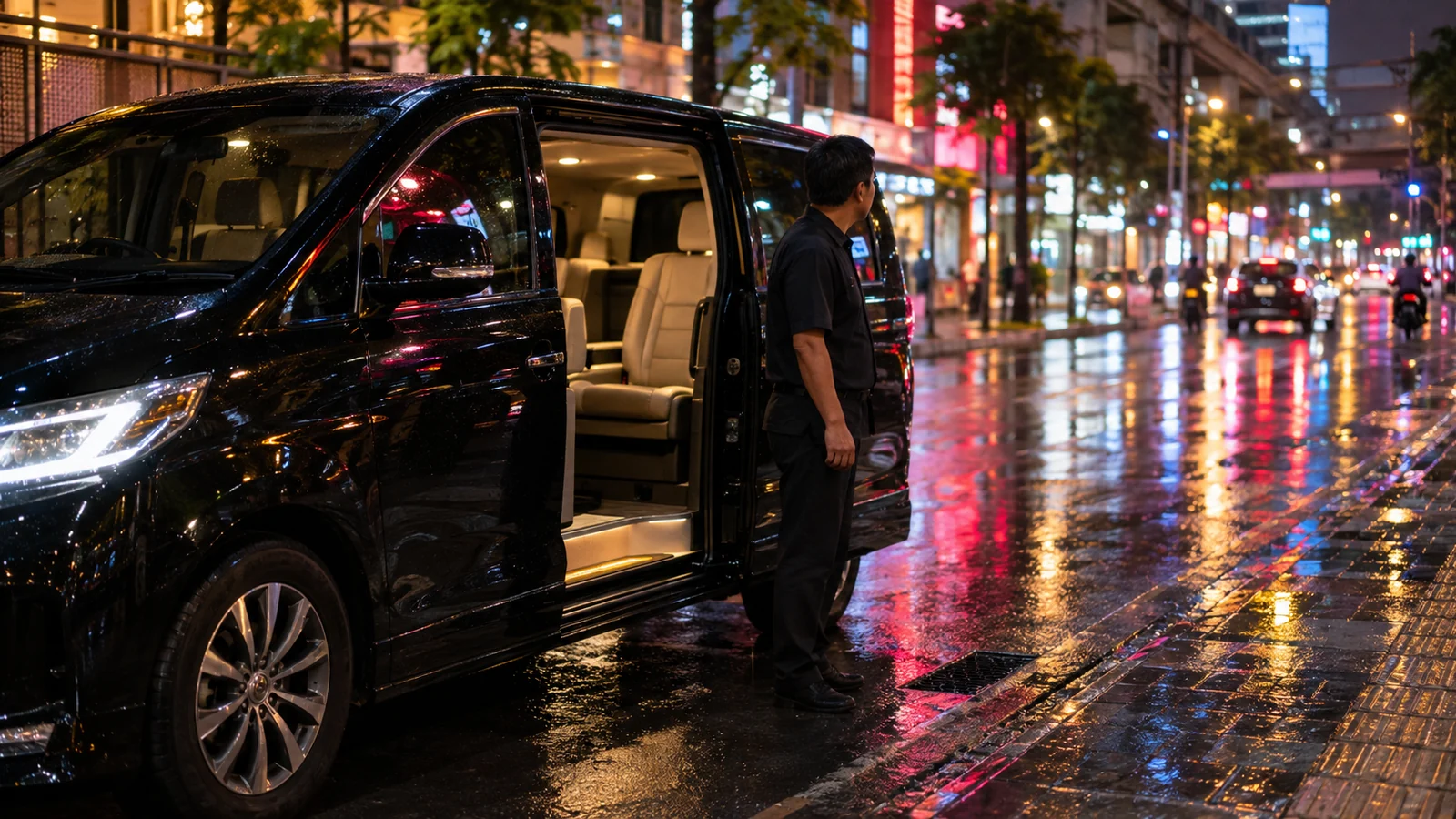
Twelve men cannot move as one group in taxis. You will split into four cars, the cars will take four different routes, two will go to the wrong place, and the group will reassemble over forty minutes. Do that three times in a night and you have lost two hours of the evening to standing on pavements.
So the group moves in one vehicle with one driver who has the whole evening's running order, not each leg as it comes. The driver knows the next address before the group does. He waits. He is reachable on one number. And on arrival day he is watching the actual flight, not the scheduled time.
Addresses are the other half of it. A Bangkok address written in English, read out to a driver who does not read English, is a twenty-minute detour. Everything on our one-page overview is written in Thai as well.
Briefing twelve men who have not read anything
Assume nobody in the group has read a single message. Plan for that and the night runs.
So the briefing is one page, it is on a phone, and it contains exactly five things: tonight's times, the addresses in Thai, the driver's name and number, the dress code, and one number to call if you are separated from the group. Not a schedule with eleven rows. Five things.
Dress code matters more here than people expect, and it is the most common reason a group is turned away at a good room. Shorts and open shoes will stop you at the door of the places you want to be in. Somebody in the group will pack only shorts. Tell them now, not at eleven at night.
And there is always one man who wanders. Not lost, not in trouble, just gone. The single number on the page exists for him.
What the groom gets told
There are two versions of any good plan. The one the group has, and the one the groom has.
We are told, by the decision maker, which parts the groom knows about and which parts are a surprise. Then we hold that line. He gets a version of the overview with the surprises removed, and if he asks us directly we tell him nothing useful, warmly.
The other side of that is what the groom does not want, and it is worth asking him straight out, privately, well in advance. Grooms have limits and they are usually specific and easy to plan around. A groom who finds out at midnight that nobody asked is not having a good night, and neither is anybody watching him.
What happens inside a private room stays between us and the group. That is not marketing copy. It is the condition of doing this work at all.
What goes wrong, and what we do about it
Five things, in order of how often they happen.
A flight is late. The most common one, and the reason the whole first night is built with the main event late. Dinner shortens, bars drop to one, the table is still there at eleven.
The head count moves. Two men drop out, one adds a brother. Room counts, van size and table minimums all move with it. A week's notice costs nothing. Two hours' notice costs a room.
One man is too far gone by eleven. This is the one nobody plans for. He goes back to the hotel, with the driver, and the driver comes back. That is a twenty-five minute problem if there is a vehicle, and a ruined night if the group is in taxis.
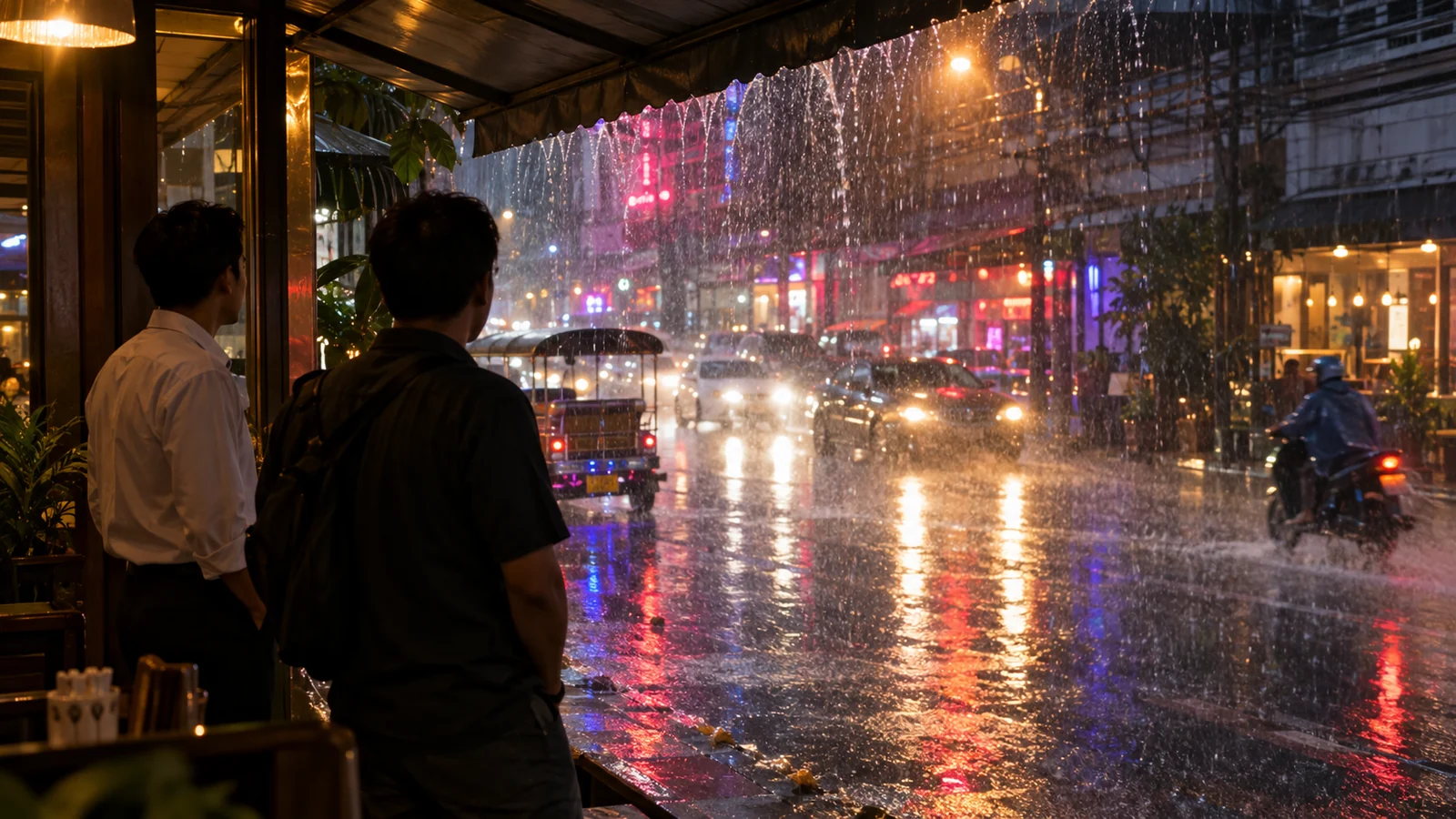
The weather. Rain in Bangkok is not drizzle and it does not negotiate. A pool party and a rooftop both need an indoor answer written down before the day, not improvised on the day.
The group changes its mind. Usually around one in the morning, usually about going somewhere else. This is fine if somebody has a phone and a relationship with the room you want to get into at short notice. It is not fine at all otherwise.
Doing it yourself, honestly
Here is the honest answer, which you will not get from anyone selling packages.
Four men, one night, a dinner and a couple of bars: do it yourself. Book a restaurant, pick two bars close together, take two taxis. You do not need us and you will not miss anything.
Ten or more men, across two or three nights, with a villa or a private room in the plan, and with one of you responsible for all of it: that is where the work changes character. It stops being a list of bookings and becomes scheduling, with dependencies. The villa needs the head count. The table needs the villa's location. The driver needs both. The groom needs a version with holes in it. And the one thing you cannot buy at any price is somebody who has already made these mistakes on somebody else's trip.
We have been planning these trips for fifteen months as Bangkok Bachelor Party. The venue we recommend for a private room night has been running for considerably longer than that and publishes its prices, which is how you can check every number in this article.
Whichever way you go, do these three things. Appoint one decision maker. Fix the two o'clock decision before you land. And write the addresses in Thai.
Questions groups ask us before they book
How far ahead do we need to start?
Four to six weeks is comfortable. Two weeks still works. Forty-eight hours is the floor for a villa and a club table together, and at that notice you take what is free.
Who do you deal with, all of us or one person?
One person. Usually the best man. We will talk to two or three people, but every decision comes back to one name.
Does the price change after we agree it?
No. The figure we agree is the figure. Anything the group orders on the night outside that agreement is the group's own bill.
Does the groom get told what is happening?
Only what you want him told. We are given one version for the group chat and one for him.
What if someone drops out a week before?
Tell us. Room counts, van size and table minimums all move with the head count, and a week is plenty of time to move them.
Can we just do this ourselves?
Yes, and for four men on one night you probably should. At ten or more, across two or three nights, the work stops being bookings and starts being scheduling.
What does a night actually cost per person?
For a private room night, The PIMP publishes ฿5,000 to ฿15,000 per person. Our packages start at ฿100,000 for the group and go to ฿450,000 for a full multi-day trip.
CONTINUE READING
THE LOGISTICS · 11 MIN READ
How a Villa Pool Party Actually Runs in Bangkok
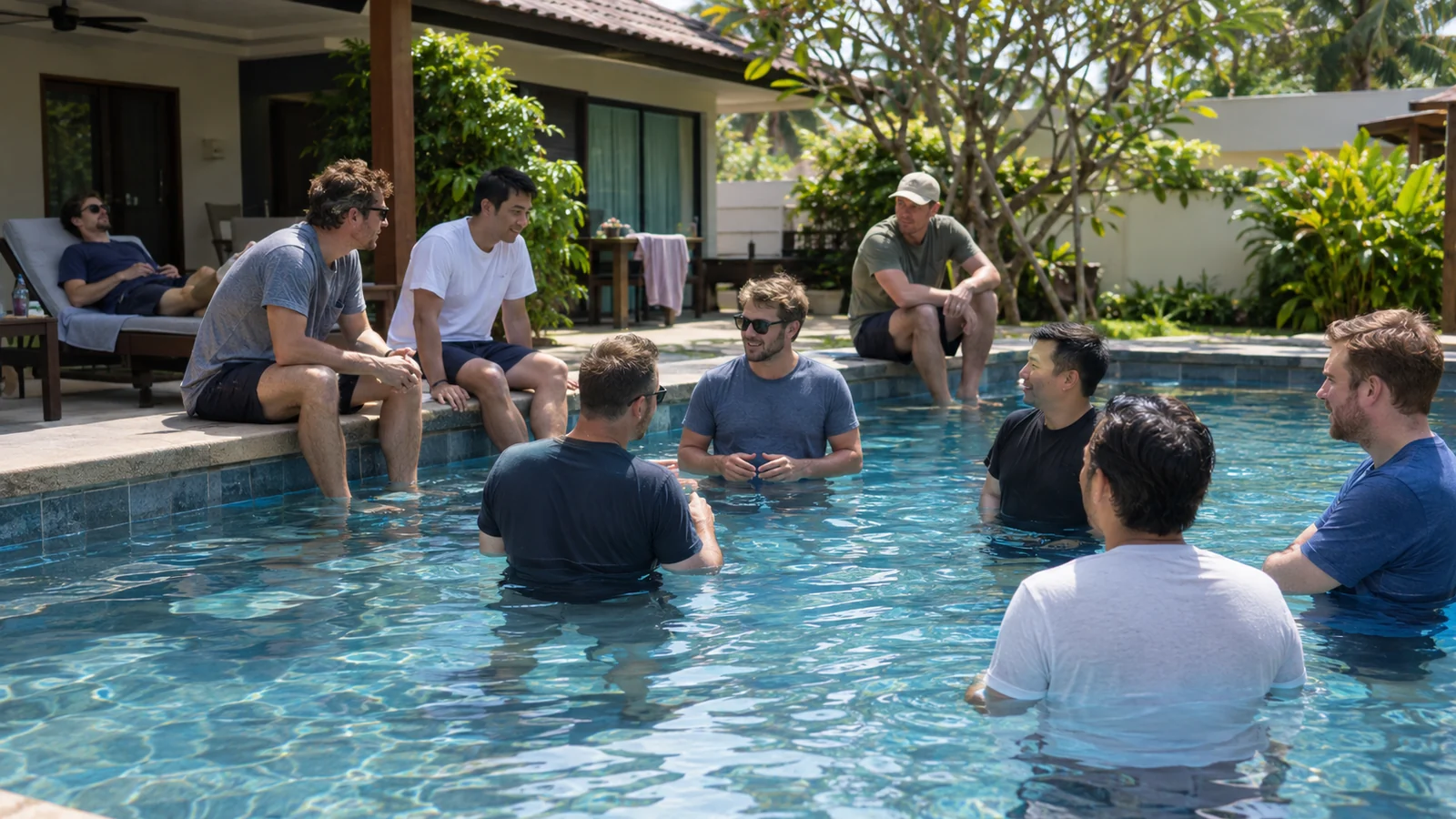
A villa day is the cheapest good hours of the whole trip, and the easiest thing to get wrong. Here is the mechanic, the money and the timing.
THE NIGHT · 9 MIN READ
How VIP Club Tables Work in Bangkok
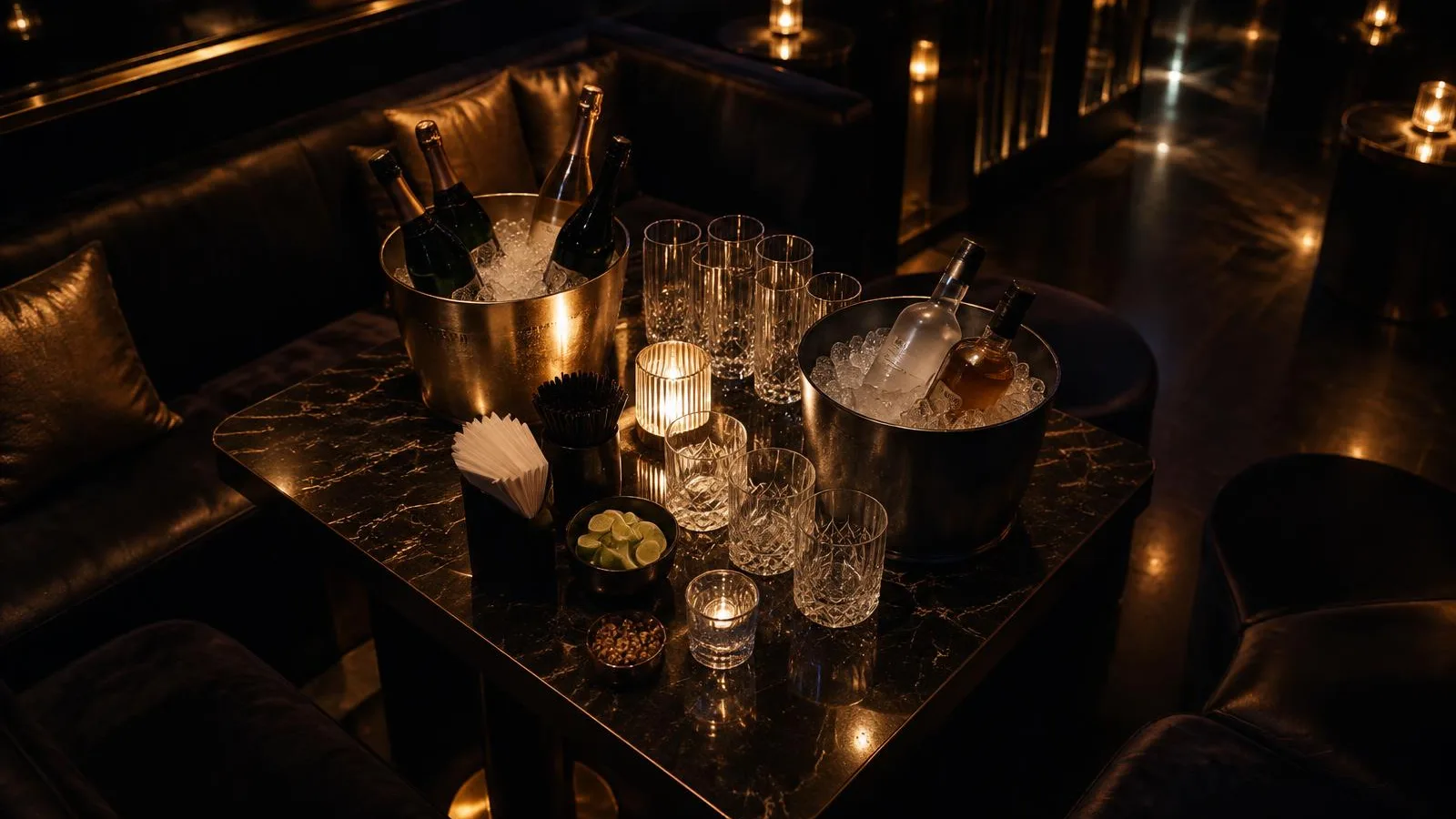
You already know how a minimum spend works. What catches groups out in Bangkok is everything around the table.